|
|
|
|
|
|
|
|
|
Pete, who produces, arranges, mixes, plays guitar, bass, melodica, and keyboards, plus programming and various other bits of audio manipulation, is a long time Hong Kong resident, with his musical roots in the Punk and Dub Reggae of the ユ70s. Indeed the term メdubモ as referred to here, has more in common with masters such as Dennis Bovell (Blackbeard), Lee Scratch Perry and Scientist, than with modern Electronica.
Musicians who have been involved in Celestial over the years include; Sunny Yeung - shakuhachi master, Eugene Pao - asia's top jazz guitarist, Hsin Hsiao Hung - Hong Kong's #1 erhu player, Sur Sudha - the musical ambassadors of Nepal, Eddie Chung - also a partner of Drum Music and now producer and deejay with Hong Kong hottest rap group 24 Herbs, plus vocalists Angelita Li, May Chan, Mariella Gonzalez, Adrian Da Silva, Rita Tsang, LiYa, Elaine Liu and many more. Occasional visitors to the Celestial Studio (Hong Kong #1 music production house: Drum Music) have included Welsh rapper John Griffiths (of Llwybr Llaethog), Mandarin rapper Antonius Chen, DeeJay Bodhi, percussionist (and Drum's architect) Johnny Kember and Zheng virtuoso Choy Kit Yee.
The first album from Celestial, メSpirit Houseモ, resulted in a Gold Disc for sales in Singapore, and tracks from that and from the second album メHappy Valley, have been included on several well known compilations, including Caf� Del Mar Volumen Ocho (S. E. Asian Release).
On メSpirit Houseモ the music reflected an East-West consciousness; an ethereal, trance-like soundtrack to a hip urban Zen Garden. First released in 1996, the album also reflects the pre-1997 cosmopolitan turmoil that was Hong Kong, and has now been re-released with a new sleeve design.
"Spirit House" draws on many diverse influences - Chinese, Vietnamese and Nepalese folk melodies, the sounds of Asian Orchestras and the rhythms of metropolitan dance floors. Drawing on the talents of musicians such as Hsin Hsiao Hung, Hong Kong's #1 Erhu (Chinese violin) player, Nepalese classical trio Sur Sudha, and world renowned jazz guitarist Eugene Pao, to name but a few, the music is a collage of many different styles: a sampled `70's funk groove loops beneath a timeless Erhu folk melody underscored by modern digital synth architecture; a 1930's Shanghai song segues into a Kathmandu Raga; sampled voice bytes from news broadcasts compete with dialogue from 1940's movies and a floating jazz guitar, an Irish folk melody is played on a traditional Chinese Zheng, with `80's analog synths and dub echo effects bubbling underneath; sound effects of trains, helicopters, bicycles, people on the move, fade in and out of the ever present hypnotic, trance like rhythms...
|
|
|
The second album from Celestial, メHappy Valleyモ is all about love, life, death, madness, mixing up cultures and time signatures, the passing of time, pollution, weather, trains, planes and automatons. Itユs not about a place - メHappy Valleyモ is a state of mind. The album reflects the mix that is Celestial; a song from 1930ユs Shanghai is backed by distorted drums and scratching, a traditional Irish tune is translated into Thai and backed by a Nepalese Trio, a Chinese melody from Taiwan is played on Japanese traditional instruments and given a laid back drum and bass backing. Interspersed by the ever-present sounds of modern life - traffic, clocks, and weather; the album is tied together by the ever-present sounds of modern music; samples, synthesizers and breakbeats.
メHappy Valleyモ was recorded at the studios of Drum Music Limited, the company which Peter founded with Eddie Chung, and which is now Hong Kongユs best-known commercial music production company. One of the tracks from the album, "Plum Crazy (Version)モ, was selected to feature on "Caf� Del Mar: Volumen Ocho", SE Asian Version. The track was loosely inspired by a Chinese traditional tune called "Plum Blossom", and features Shakuhachi over a reggae backing. The album also features: LiYa (a GuangZhou TV presenter) on mandarin vocals; Rita Tsang on English vocals; Shakuhachi (Japanese flute) master Sunny Yeung; Koto (Japanese harp) expert Emiko Hisada; Erhu (Chinese Violin) soloist Hsin Hsiao Hung; Nepalese Trio Sur Sudha; internationally renowned Jazz Guitarist Eugene Pao; DJ Bodhi on decks, Welsh Rapper John Griffiths (of Llwybr Llaethog fame), Johnny Kember (Drum's Architect) on Congas, to name but just a few.
|
|
|
|
|
 |
|
|
he third in the series of albums from Celestial, メHong Kong Dub Stationモ once again invokes a pan-Asian dubscape of hypnotic rhythms and deep space textures. Another tectonic phase shift from Celestial merges the sounds of 70ユs Jamaican b-sides with top Asian instrumentalists and digital tech-know-how. Rhythms and sounds from dub plates, collide with melodies and textures through zen temple gatesノ Trip the light dubtastic in the dancehall of the mindノ
Musicians featured again include Hong Kongユs number one Erhu Player, Hsin Hsiao Hung; the Musical Ambassadors of Nepal, trio メSur Sudhaモ; Hong Kongユs very own Shakuhachi Master, Sunny Yeung; Asiaユs jazz guitar genius, Eugene Pao and flitting between China and France, Dave Packer on Harmonica. Multi-talented vocalist Angelita Li offers vocals in English and Portuguese, though sheユs just as much at home singing in Cantonese or Mandarin. And rapper/producer Eddie Chung (Co-Founder of Drum Music) supplies some Augustus Pablo style Melodica...
All brought together once again by producer Pete Millward in this the third empyreal collaboration under the name Celestial:
メThis year I brought a lot of my old vinyl from the ヤ70ユs out to Hong Kong, which is mainly Punk and Reggae. And although thereユs not a lot of Punk influence on this album, I did end up playing a lot more guitar and bass than before. I also worked with Shakuhachi Master Sunny Yeung to create some new tracks from improvisation ミ and Sur Sudhaユs new Sitar player (the last one had a bizarre gardening accident), Professor Tara Bir, solos like Jimi Hendrix ミ in fact itユs a bit of a Freestyle Sitar Odysseyノモ
With the completion of メHong Kong Dub Stationモ some of Hong Kongユs outstanding video artistes have created two new videos for tracks from the album ミ bringing to four the number of Celestial videos now completed. These can be seen at www.hongkongdubstation.com along with all the sleeve artwork, with hi-res downloadable versions, and some other images.
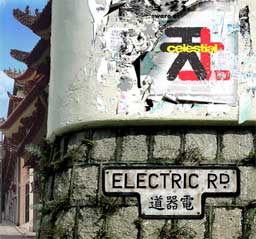
メElectric Road 電器道モ is the fourth album from Hong Kong collective, Celestial 天上, in which they dive deeper into the underwater world of dub electronica. Although Electric Road is the name of a real street in Hong Kong, the album is not really about that street, but rather the name serves as a descriptor for an imagined sound-scape, or subterranean mind-space, somewhere nearer the bottom of Hong Kong's harbour. Ten years after the Handover, and ten years on from the first Celestial album, Electric Road celebrates the vibrancy of 21st Century Hong Kong, as exemplified by the life on the streets. But the album also reflects on the emptiness of modern day life, and the way in which culture and heritage in Hong Kong are often swept aside in the name of 'progress', and profit:
"Some of this album might seem dark" says producer Pete Millward, "but I've been disappointed this past year; disappointed and confused the Hong Kong governmentユs complete disregard for heritage, as evidenced by by the tearing down of the Central Star Ferry Pier and its replacement with a Stalinist Mausoleum, the fated demise of Queenユs Pier, the inexorable filling in of the harbour, the seemingly inevitable trashing of the Soco Islands for an LPG terminal, and this administrationユs indifference to the environment in general ミ in short, the Hong Kong that we live in. Amongst other things..."
The artwork (a photo-montage created from scratch by Pete ミ hence the schoolboy errors) shows a surreal Hong Kong street - but don't bother looking for it in Hong Kong - it doesn't really exist, perhaps like the false memory of a perfect chimerical past that is reflected in the fluid ripples of the dubscape.
Several of the tracks started life as instrumentals that Pete wrote for The Bass Cadets, the live dub band that he performed with at Rockit (the Hong Kong music festival) a few years back. Musically, メElectric Roadモ pushes the envelope already stretched in the previous three Celestial CDs, that of deep textural dub-electronica, flavoured with Asian instrumentalists, occasional vocals and other-worldly samples. The album once again features Asia's guitar giant, Eugene Pao (包以正), HK's number one Erhu player Hsin Hsiao Hung (辛小紅), and Shakuhachi master Sunny Yeung (陽光). Newcomers are Koto virtuoso Fukuhara Sawako (福原 左和子), plus vocalists May Chan, well known in Hong Kong for her session work as "細 May", Adrian Da Silva, leader of Hong Kongユs AudioTraffic (winner of the Hong Kong leg of Battle Of The Bands), and visiting from New York, Mariella Gonzalez. There is also a reunion of Mandarin and Welsh Rappers, Antonius Chen and John Griffiths, who both first contributed to the second Celestial album, "Happy Valley". And Pete supplies all the other guitar, bass, melodica, keyboards, production, programming and mixing.
With Eddie Chung, Pete founded Drum Music Limited in 1997 in Hong Kong ミ for more info please go to: www.drummusic.net
More on the Musicians and their instruments:
|
|
|
 |
|
|
|
SUNNY YEUNG Shakuhachi
Sunny Yeung is an Architect, a non-practising Barrister, Arbitrator and Mediator.
Before picking up the Shakuhachi, Sunny was an flautist holding the position of principal flutist with various amateur orchestras in Hong Kong.
He studied Shakuhachi playing with Dai Shihan (Grand Master) Dr. Riley Lee in Australia for four years and completed the entire repertoire of the Chikuho-ryu school. With the blessing of Dr. Lee, Sunny furthered his study of the Watashimido lineage of Honkyuku with the leading exponents, Katsuya Yokoyama and Tajima Tadashi, in Japan.
While in Australia, Sunny performed and presented workshops at various concert halls, Universities as well as the Sydney Opera House.
Since returning to Hong Kong, Sunny performs regularly and teaches the Shakuhachi privately. He has performed as a member of the Celestial collective on two CDs: メHappy Valleyモ and メHong Kong Dub Stationモ.
THE SHAKUHACHI
The Shakuhachi is an end blown flute with five finger holes. Originated in China, it came to Japan in the seventh century. It has been associated with religious practices from before the fourteenth century. Particularly well known are the Fuke Monks that played the Shakuhachi, known as Sui-Zen (Blowing Zen) rather than singing Buddhist chants. During the Edo period (1600-1868), it was the primary focus in the meditative life of the komuso, wondering mendicant monks. The komuso were often Samurai in disguise who used the Shakuhachi as a weapon when swords were banned. Today the Shakuhachi can be heard in many diverse settings from jazz clubs to symphony halls.
|
|
|
 |
|
|
Eugene Pao
Eugene is the first jazz artist in Hong Kong to sign with major international labels. He has made 3 solo albums, 6 group albums, has featured on numerous local albums for canto-pop stars as, and composed many film soundtracks and TV commercials. He has over the years recorded with jazz greats Jack Dejohnette, Mike Brecker, Eric Marienthal, John Patitucci, Marc Johnson, Eddie Gomez, Kenny Wheeler, Jimmy Witherspoon, Dan Gottlieb, Jeff Andrews, James Genus and Joey Calderazzo; his latest release was recorded in Denmark with top European jazz musicians Mads Vinding & Alex Riel.
He has performed on stage with ChickCorea, Herbie Hancock, McCoy Tyner, Terumasa Hino, Freddie Hubbard, Jackie McClean, Joe Pass, Ulf Wakenius, Martin Taylor, Kazumi Watanabe, James Moody, Bob Berg etc. Eugene travels all over the world for performances at International jazz festivals, concerts, jazz clubs & recording projects
Sur Sudha
Sur Sudha is known as Nepal's MUSICAL AMBASSADORS' and are devoted to making music to disseminate a universal message of peace and harmony supporting the effort alleviate poverty from the face of the earth. Through its music, Sur Sudha bring to the world the message of peace propounded by its son of the soil, Lord Buddha and demonstrate how two of the world's great religions-Hindu and Buddhism-find perfect fusion in Nepal. Sur Sudha seek to promote these ideals through traditional Nepali instrumental music rendered with the flute, sitar and tabla; three instruments most popular in Nepal ミ Sur Sudha consist of three sons of Nepal
These three talented musicians have built a reputation for their innovative interpretations of traditional Nepali folk tunes and for composing their own original music, stretching the parameters of a formal setting of a trio. Their CD albums showcase the virtuosity of the individual musicians and offer listeners an opportunity to go on a musical journey through Nepal ミ from the Tarai (pastoral lowlands) to the remote areas of Mustang, nestled high in the mighty Himalaya.
Sur Sudha have held more than 2,000 concerts, on the steps of ancient Hindu temples to the concert stages of Europe, India, Japan and the USA, and have been the subject of TV documentaries in France and Germany. As well as featuring on the three Celestial albums, the trio has already released four CDs: Melodies of Nepal, Images of Nepal, Festivals of Nepal and Third Eye ミ apart the last one, the others are all available world-wide.
Internationally Sur Sudha's music is widely recognized by music companies: Sur Sudha held second position in KALX WORLD MUSIC CHART for the week ending May 11, 1998 as the most frequently played international music. They were also in the top ten of the KALX World Music Chart for months in 1998.
|
|
|
|
|
|
|
|
|
インターネットラジオ ラジオエーゲ海は、Japanインディーズサウンドはもちろんのこと、日本が大好きな世界のロックミューズ達、超レアアジアンインディーズサウンド、世界のインディーズサウンド、サイケデリック、テクノ、エレクトロ、ヒップホップ、ポップ・・・。ジャンルを問わず世界のインディーズサウンドを24時間365日配信中!!
Internet Radio Radio Eigekai brings you hottest tunes from Japanese indie music scene, Rockin muses around the world, absolutely rare Asian indie sound scene, superb indie artists around the world and more and more. 24hrs 365 days. Pop, Techno, Psychedelic, Hip Hop Electro, Dance.........listen what you looking for here ! |
| ラジオエーゲ海Topへ | Radio Eigekai Station Home |
|
|
|
|
|
 |
|
|
|
|
|
|
|
|
|
|
|
|
|
|